Research

We offer innovative, customised solutions to scientific challenges.
Our team of highly qualified engineers and scientists have a wide range of skills, from magnetics to mechanics and cryogenics.
We use cutting-edge software such as Opera, Ansys, Tosca, Elektra, Solidworks, Tempo and Quench to design mounts, frames and reinforcement structures to meet research needs. We value long-term partnerships with our customers, based on trust and collaboration.
Sigmaphi electromagnets at the heart of discovery: In close collaboration with world-renowned laboratories and international research centres, our precision electromagnets equip the most advanced particle accelerators. This cutting-edge equipment makes it possible to explore the fundamental constituents of matter with great precision and reveal the secrets of our universe.
We use cutting-edge software such as Opera, Ansys, Tosca, Elektra, Solidworks, Tempo and Quench to design mounts, frames and reinforcement structures to meet research needs. We value long-term partnerships with our customers, based on trust and collaboration.
Sigmaphi electromagnets at the heart of discovery: In close collaboration with world-renowned laboratories and international research centres, our precision electromagnets equip the most advanced particle accelerators. This cutting-edge equipment makes it possible to explore the fundamental constituents of matter with great precision and reveal the secrets of our universe.
They trust us









Discover some of Sigmaphi's key research projects
Resistive magnets
Superconducting magnets
Pulsed magnets
Resistive magnets
SLS2.0 Quadrupole I PSI
For the upgrade of the light source (SLS) at the Paul Scherrer Institute (PSI) 112 quadrupoles were produced and delivered for SLS2.0.
Gradient: 93 T/m
Aperture: 21 mm
Mechanical tolerance on aperture diameter: ± 0.5 mm
Mechanical tolerance on interpolar distances: ± 0.03 mm
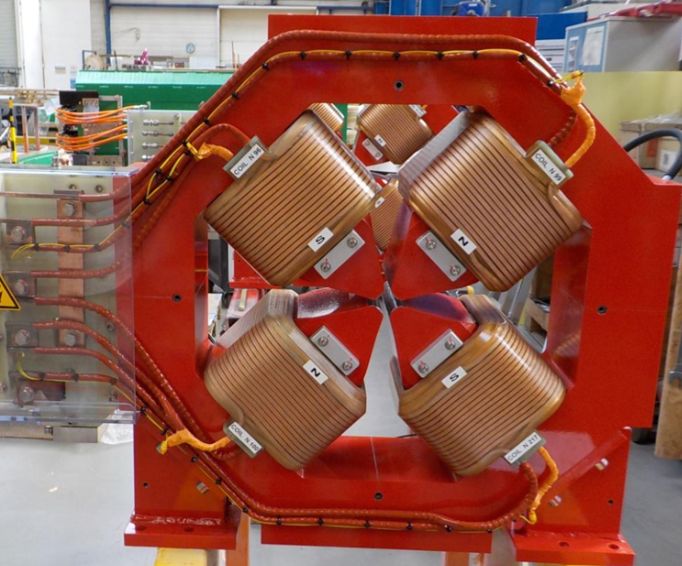
S3 Quadrupole Triplet I GANIL
The quadrupole triplet is an essential component of the SPIRAL 2 accelerator’s S3 beamline.
It consists of three magnetic quadrupoles that focus and control the particle beam.
Combination of quadrupoles and sextupolar components
Gradient: O,5 T/m
Ouverture: 340 mm
Courant maximum: 985 A
Gradient: O,5 T/m
Ouverture: 340 mm
Courant maximum: 985 A
ANL | APS-U – 246 Storage ring quadrupoles
As part of the upgrade of the light source at Argonne National Laboratory (ANL Advanced
Photon Source) in Chicago, Sigmaphi supplied 246 quadrupoles.
Aperture: 26mm
Integrated gradient: 13T
Integrated gradient: 13T
INFN SPARC-LAB solenoid
The Italian Nuclear Physics Institute (INFN) and Sigmaphi have collaborated on a number of occasions.
In particular, Sigmaphi has supplied 2 solenoids for the linear electron accelerator of the SPARC-LAB of the
Frascati National Laboratory (LNF).
12 coils per solenoid
Length: 3m
Max. field strength: 0.18T
Length: 3m
Max. field strength: 0.18T
MAINZ | MESA - Dipoles
The Institute of Nuclear Physics at Johannes Gutenberg University in Mainz, Germany, is currently building the MESA electron accelerator.
MESA electron accelerator. This new accelerator will be one of the world’s few ERLs
(Energy Recovery Linac) in the world, a system in which the energy of decelerated electrons is used to accelerate new particles.
the acceleration of new particles. Sigmaphi designed and manufactured the 101
dipoles in the installation.
Nominal fields: 50 – 600 mT
Gap: 30mm – 50mm
Gap: 30mm – 50mm
HESR Dipole & Quadrupole I FAIR
The FAIR international accelerator, one of the world’s largest research projects, is currently under construction in Darmstadt, Germany. At FAIR, matter that normally only exists in the depths of space will be produced in a research laboratory. Scientists from all over the world will be able to gain new insights into the structure of matter and the evolution of the universe from the Big Bang to the present day.
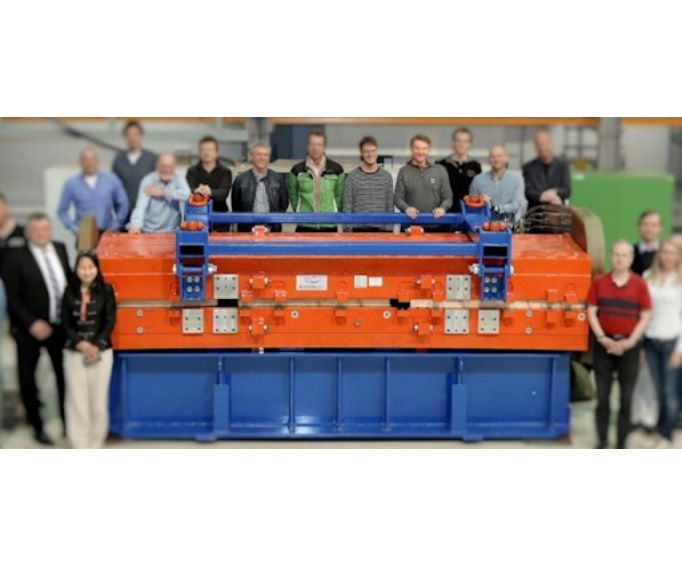
42 Dipoles
GAP 100 mm
Max. field strength: 1.7T
Max current: 3000A
Total weight: 35 tonnes
GAP 100 mm
Max. field strength: 1.7T
Max current: 3000A
Total weight: 35 tonnes
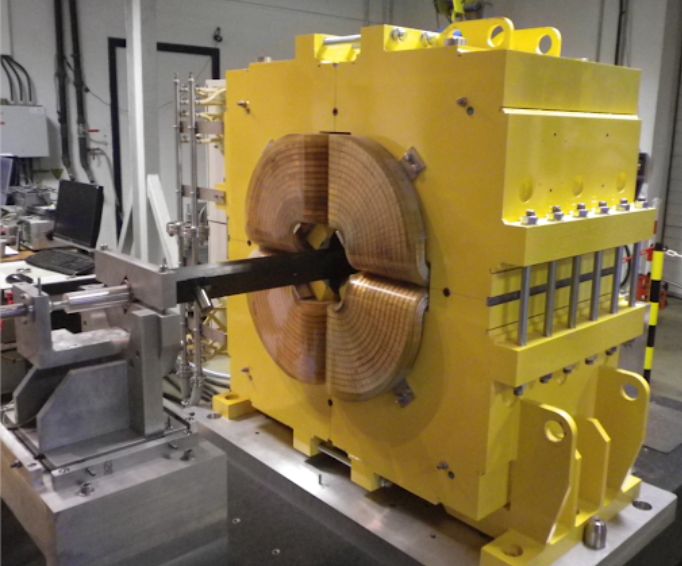
86 Quadrupoles
Opening diameter: 100 mm
Maximum gradient: 25T/m
Maximum current: 760A
Total weight: 7 tonnes
Opening diameter: 100 mm
Maximum gradient: 25T/m
Maximum current: 760A
Total weight: 7 tonnes
Superconducting magnets
SHMS Dipole | JLAB CEBAF Upgrade
Jefferson Lab has upgraded the CEBAF accelerator to 12 GeV/c and is developing new experimental facilities.
Room C is building an 11 GeV/c superconducting spectrometer for high-energy nuclear physics experiments. Sigmaphi built the Q2Q3 quadrupoles and the dipole for the SHMS.
Room C is building an 11 GeV/c superconducting spectrometer for high-energy nuclear physics experiments. Sigmaphi built the Q2Q3 quadrupoles and the dipole for the SHMS.
24 tons, warm bore 600mm,
4,25T NbTi
Liquid helium 4,2K
3500 A
Liquid helium 4,2K
3500 A
WAVE Vector Magnet | CEA
The Wave magnet is the result of a collaboration with the CEA.
A demonstration magnet capable of producing a magnetic field in any direction.
1T/1T/1T Bore diameter 100 mm NbTi Liquid Helium Zero boil off – 200 A High field homogeneity 50 ppm within R5mm Turn key sytem delivered with 4 power supplies and quench protection system
Q4 R&D Quadrupole | CERN Hilumi
The Hilumi project for high luminosity aims to increase the performance of the Large Hadron Collider, the LHC, by a factor of 10.
This will make it possible to increase the number of collisions and collect more data.
Double aperture quadrupoles ID 90 mm
Gradient 120 T/m (peak field 6,1 T)
Length 4 meters – NbTi
1,9K – 4596 A
Gradient 120 T/m (peak field 6,1 T)
Length 4 meters – NbTi
1,9K – 4596 A
Pulsed magnets
In vacuum septum system | SOLEIL
Soleil is France’s national source of synchrotron radiation, producing extremely bright light that can be used to analyse inert or biological matter down to the atomic scale.
Field 0,5 T Sinus wave 120 μs 5500 A – 1 kV
Rep. rate 3 Hz
Leakage field < 10 ppm (eddy current shielding)
Magnet in vacuum 5. 10-9 mbar – Yoke laminated
Rep. rate 3 Hz
Leakage field < 10 ppm (eddy current shielding)
Magnet in vacuum 5. 10-9 mbar – Yoke laminated
In vacuum Injection kickers system magnets | FAIR HESR
The FAIR international accelerator, one of the world’s largest research projects, is currently under construction in Darmstadt, Germany. At FAIR, matter that normally only exists in the depths of space will be produced in a research laboratory. Scientists from all over the world will be able to gain new insights into the structure of matter and the evolution of the universe from the Big Bang to the present day.
Field 64 mT per kicker
220 ns rise time / fall time
flat top 500ns
Solid state pulser 4200 A – 35kV
Magnets in vacuum 5. 10 – 9 mbar
Yokes in ferrite
220 ns rise time / fall time
flat top 500ns
Solid state pulser 4200 A – 35kV
Magnets in vacuum 5. 10 – 9 mbar
Yokes in ferrite
Kicker magnet | Thom X (SOLEIL)
ThomX is an electron accelerator designed to generate X-rays. It is installed in the IGLEX on the Paris-Saclay campus in Orsay (France). The X-rays produced by this accelerator will be used for radiography, radiotherapy, tomography, spectrometry and many other applications.
Field 17,6 mT
Half sinus 120ns
740 A – 15.5 kV
Rep. Rate 50 Hz
Magnet in air
Yoke in Ferrite
Vacuum chamber in ceramic